Jesus’ Ascension
by
Clyde Kunz
Reading: Acts 1: 6-15, John 17:1-11
At risk of seeming entirely cynical, if not inappropriately irreligious, I have to tell you that the description of Jesus' Ascension from the Book of Acts has always reminded me of a 1950's comic book hero riding into the sky wearing a jet-pack on his back (which is, of course, at the time only existed in the mind of a science-fiction writer but has now become reality.)
I simply find it hard to visualize a "flying Jesus" - even if He is wearing a modern-day jet-pack.
And I also struggle with the concept of Heaven being a place up above us in the clouds somewhere. Not that I pretend to know where Heaven is, I just don't quite believe it is hovering up above our heads.
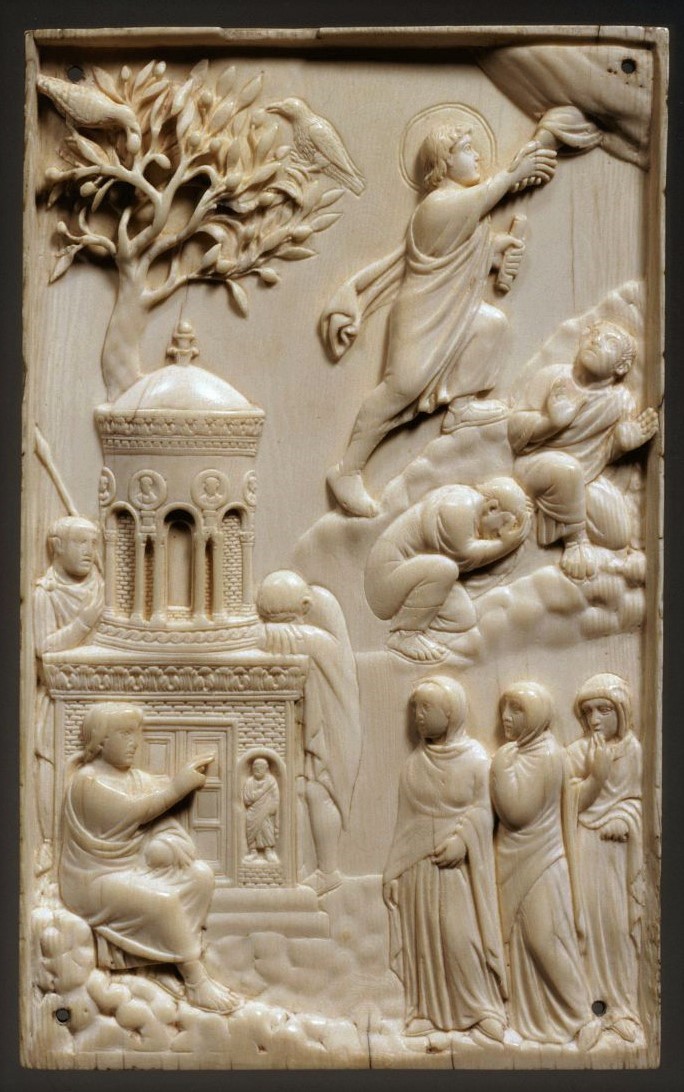
That said, I love seeing depictions of events from the Bible as imagined by visual artists. The earliest-known artist rendering of the Ascension was carved into an ivory plaque which is now in a museum in Munich and dated to about the year 400. In it, Jesus - not flying - is clearly climbing up a mountain with the hand of God reaching down through a cloud to grasp Jesus' hand, pulling Him up into the clouds like a father helping his young child out of a swimming pool.
Throughout the centuries since that earliest depiction, artists have imagined this scene of the Ascension in various ways, sometimes showing Jesus rising in an almond-shaped light, sometimes being lifted by angels, often shown blessing the apostles below, and sometimes with only His feet or lower legs visible as He is swallowed up in clouds.
During the Renaissance, artists tended to place Jesus in dramatic church scenes as He ascends; later adding theatrical, airy perspectives with the sun illuminating a floating Jesus from behind. In the 20th century the surrealist painter Salvador Dali painted a "cosmic" ascension, showing Christ from below (the bottom of His feet being the painting's dominant feature) ascending toward a molecular-looking atomic structure.
All of which leaves me wondering what it was really like. As with the angel Gabriel and Mary at the Annunciation, or in front of the tomb at Christ's resurrection, I find myself asking the question: "Had the video function on an I-phone 16 been recording all this, what would the play-back actually show us?" Or were they all events impossible to capture on film?
Those earliest Christians, following the Resurrection, had an opportunity to experience the risen Christ in several ways (although often not initially recognizing Him). My supposition - and it is ONLY a supposition! - is that, little by little, those experiences of the risen Christ became fewer and farther between, and - in an effort to come to some understanding about where He had gone - a theory about a an ascension into Heaven came into being.
[Now I suppose I've just invited at least one of you to phone the Bishop tomorrow morning to let her know that I'm preaching heresy at St. Matthews! But - trust me - it wouldn't be the first time she's heard it.]
But whether it happened exactly as described, I believe Luke (who is believed to be the writer of Acts) includes this morning's depiction for reasons that may or may not have anything to do with an actual physical event.
There must have come a moment when the people realized they would no longer have Jesus with them, and they needed to figure out how - and whether - to move forward on the path He'd taught them. Their Rabbi - this Jesus - wouldn't be around anymore. For them, there was the time they had with Jesus, and the time that came after. The Ascension is the point that sits in the middle of the two. And at least at some level they must have felt a sense of abandonment.
It's hard for me to imagine that anyone who's lived into adulthood has not at one time or another felt abandoned by God. That even the words of our prayers seem to dissolve in the air in front of us the moment we speak them. That the "I will always be with you" promise doesn't always feel as though it's being honored.
But I do not for a second believe that God abandons us and I wonder if at those times God is simply trying - like any good parent - to say: "It's time for you to step up; it wouldn't be good for you if I simply solved every problem. It's time for you to do what needs to be done. You've got this."
We see this happening right at the beginning of the Acts reading - and it's probably indicative of human nature - that those present asked Jesus: "Lord, is this the time when you will restore the kingdom to Israel?" Please make note of their question: "....is this the time when YOU will restore the kingdom...?"
Even now, in this final time with the risen Christ, when one might think they should know better, they are still expecting HIM to do all the work! And how does Jesus respond? By saying that He expects THEM to now do the work, being His witness "in Jerusalem, in all Judea and Samaria, and to the ends of the earth."
After He is lifted up, we are told the angels ask those present: "Why do you stand looking up into Heaven?" In other words, don't you guys get it? He's not coming back right away. He needs YOU to get up, go to Jerusalem, go back to that upper room, and start figuring out next steps. Which is of course what they finally do.
Reading these verses over and over, I came to realize how much we can be like those early followers. We are searching for our new Rector. And we too often slip into the fantasy of wanting to find a priest who will do the work for us - someone who will be responsible for growing the congregation, for the day-to-day administrative work and balancing the budget, someone who will strengthen and expand outreach ministries, who will be engaged with the neighborhood, who will expand adult education offerings, etc. In other words, planning to ask our new priest - like Jesus' followers - "....is this the time when YOU will restore the kingdom...?"
One of the most interesting verses in today's reading isn't part of the reading at all. We ended today at verse 14. In the next verse we are told that "Peter stood up among the believers (together the crowd numbered about 120 persons."
Huh. After all Jesus' teaching, all of the crowds following Him during His ministry, the Sermon on the Mount, the feeding of the 5,000 and all the rest of it, it seems that most had fallen away after the crucifixion. At this moment in time, the congregation of Jesus' followers numbered just 120 people. And when they kept waiting, expecting Jesus to come right back to do the work of restoring the kingdom of Israel, He said "No. It's your time. YOU need to do the work."
And they did. They got organized. They replaced Judas Iscariot as one of the Twelve. And they followed Jesus' directives, carrying the Gospel to the ends of the earth. The Apostle Thomas was sent east - believed to have ended up in India. Peter went to Rome after helping to organize the Church in Jerusalem, Others went to North Africa or to present-day Turkey or Greece.
Just 120 people established the Church and they grew it, and grew it, and grew it. And while I have to assume they had some incredible help and inspiration from on high, Jesus was NOT the "boots on the ground" they had hoped and expected would do the work. They needed to do it themselves.
Thinking about those 120 saints, I sat down the other day with our most recent parish directory and simply counted names. Although we don't see everyone every Sunday morning, we number about 100. And I ask myself: if 120 people - suffering unimaginable persecutions and the flat-out difficulties of daily life and travel in the 1st century - could establish the Christian Church that has grown into the world-wide faith we know it to be today, how much potential do we have - 100 folks here at St. Matthews - to simply grow our own congregation? To be His witness "in Jerusalem, in all Judea and Samaria, and to the ends of the earth." Or we might say, in our neighborhoods, within our circles of families and friends, among co-workers?
John chapter 17 is part of Jesus' farewell discourse, which began I believe back in chapter 13. But here in this chapter we have Jesus' prayer for the Church, praying that those 120 souls - and by extension all of us today - find unity and strength. It is a prayer of encouragement for the Church and its members.
It strikes me as odd that Jesus is going along, delivering this discourse, and - without removing Himself to pray in private - offers a very public prayer for the people. Aloud, in front of them, talking with God about them within their earshot.
And that made me realize how often I tell someone that I will keep them in my prayers. [And - just so you know - when I say that, I really do]. But including someone in private prayers is very different than praying for them aloud and in their presence. Doing so requires a certain vulnerability, and I know that for my part I would probably feel really uncomfortable. It might also make the person being prayed for feel uncomfortable and self-conscious.
But being prayed for can be really powerful, allowing one's self to surrender to the power of another's prayer. When someone shares a personal crisis or minor tribulation with you, can you imagine facing them and saying "Let me pray for you," then taking their hands in yours and offering - out loud - a sincere prayer on their behalf? Even if it's in a public place and strangers are witnessing it?
And how might being the recipient of such a prayer make you feel? Scared? Nervous? Embarrassed? Deeply self-conscious? Or might it also make you feel truly loved? Truly seen? Truly heard by that other person?
I'd like to challenge myself and each of us to consider giving it a shot. Praying aloud for someone in their presence. Maybe sometime soon, you or I may find ourselves talking with someone who could really use a good prayer. Will we be brave enough to take the initiative and follow Jesus' example by saying, "Let me pray for you. Right here. Right now." And then doing it.
Jesus taught us many good things by example. Maybe this example of prayer in today's Gospel is among the most important.
©2026 Clyde Kunz
Clyde Kunz is an Honorary Canon in the Diocese of Arizona and a gay man in a 40 year relationship.
| Main Menu | Back to What's New |